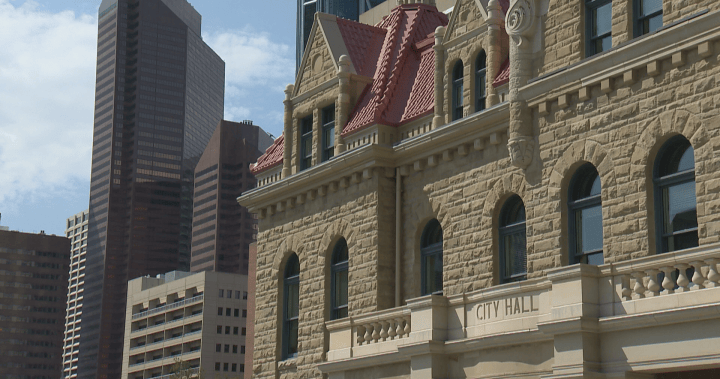
Calgarians could be facing the largest property tax increase in at least 30 years if the city’s four-year budget proposal is approved by city council.

The four-year budget, titled “Investing for the Future,” was presented to city council Tuesday, with spending focused largely on infrastructure and public safety.
The first year of the plan includes nearly $600 million in new spending in 2027 as well as $4.4 billion in capital funding for city infrastructure like water, roads and recreation facilities.
It proposes a 15 per cent property tax increase in the first year, a 10 per cent increase in 2028, a 7.7 per cent hike in 2029 and a 6 per cent increase in the budget’s final year in 2030.
“It’s public safety, it’s largely the police, it’s the fire department, it’s essential infrastructure that’s driving this level of increase,” Mayor Jeromy Farkas told reporters. “But I want us to get significantly lower.”
As proposed, the budget would result in an extra $53 cost per month for the typical residential property assessed at the median of $688,000 in 2027, which includes an additional $16 per month due to a proposed increase in waste and recycling fees as well as water bills.
Calgary Transit fares are also set to increase by 3.8 per cent, and adult leisure centre admission is expected to cost Calgarians an extra 3.1 per cent in 2027.
Those figures are subject to change during budget deliberations later this month.
“The budget that we tabled today, it’s a reflection of the input we’ve received from Calgarians, as well as council’s priorities, and the direction they’ve given us,” said David Duckworth, the city’s chief administrative officer.
The proposed property tax increase is set to pay for a portion of the slew of new investments included in next year’s budget, including $187 million for public safety initiatives like police and fire, a $134 million boost for Calgary Transit, as well as $256.3 million in ongoing operating and one-time funding for infrastructure.

Get breaking National news
Get breaking Canada news delivered to your inbox as it happens so you won’t miss a trending story.
The city’s operating budget is also set to grow by $2 billion over the next four years, according to the budget proposal, with 1,800 new positions set to be hired by 2030.
The four-year budget also proposes $21 billion in recommended capital spending over four years, including $13 billion in new capital infrastructure.
Notable investments include $1.7 billion for the Pine Creek and Fish Creek wastewater treatment plants, $616 million for other water infrastructure, $420 million for roadway improvements, $102 million for new fire and emergency response stations and $300 million to purchase new transit buses.
The budget also proposes $284 million for projects through the GamePLAN strategy including the Forest Lawn recreation facility replacement, Kingsland and Belmont athletic parks and the city’s portion of the Foothills Fieldhouse; another $66 million has been set aside to maintain arenas, aquatic centres and the Calgary Soccer Centre.
“This has the largest capital program the City of Calgary has ever seen,” said the city’s chief financial officer Les Tocher.
To help pay for that new infrastructure spending, the City of Calgary is planning for additional borrowing that would see the city’s debt rise from $4.2 billion in 2027 to $10 billion in 2030 and take up 80 per cent of the city’s debt capacity.
The budget document warns that although debt remains within council-approved limits, more debt will increase the amount required for debt payments and “reduce the funding flexibility available for future priorities.”
“It’s something I’m concerned about as far as we’re pushing the envelope,” Ward 10 Coun. Andre Chabot told reporters, but he noted the debt levels are expected to change during each budget adjustment over the next four years.
The Calgary Police Service is expected to receive its full funding request to city council, its largest in the service’s history, which includes $3.1 billion in operating funding for the next four years as well as $192 million in capital funds for facilities, vehicles and equipment.
Farkas, however, said that request might need to be clawed back during budget talks due to its impact on the property tax increase.
“We can’t give any department, even the police, a free pass when it comes to their budget ask,” Farkas said Tuesday. “We’re going to be relentless. We’re going to absolutely grill our city administrators on proving the need.”
Others on council, like Ward 13 Coun. Dan McLean, pointed to funding community partners like the Calgary Zoo, the Calgary Arts Development Authority and the Calgary Library, as potential reductions.
“I’m not against these civic partners, they have value,” McLean said. “But every year it’s give me more, give me more. Maybe this year is the year we say let’s hold it tight.”
The budget proposal also includes $102 million for new fire stations, and $52 million for Calgary Fire Department vehicle replacement and lifecycle upgrades.
There’s also $27 million proposed to increase the number of transit peace officers, $8 million for additional Community Standards peace officers and $4 million for additional traffic safety peace officers.
Property values in Calgary are expected to decline slightly in 2027, with preliminary figures showing the assessed value of a single residential property is expected to drop 2.5 per cent from $706,000 in 2026 to $688,000.
The typical condo assessment is also projected to drop 5.6 per cent in 2027 to $327,500.
The lower assessments are expected to result in a reduced education property tax payment for Calgarians after the provincial government announced a standardized rate that is frozen for the next three years.
According to city officials, the provincial property tax is expected to drop 6.4 per cent due to the change in assessments and projected to result in $125 in savings for the typical homeowner in 2027.
However, others on city council are preparing to work to whittle down the property tax increase for Calgarians when budget deliberations begin on Nov. 23.
“We as a council will now need to sharpen our pencils,” said Ward 4 Coun. DJ Kelly. “At this point it’s really going to be about getting that number down to a place where we can balance the sustainability of our infrastructure and our city services, with the affordability Calgarians are expecting.”
Leave a Reply