Every marathon begins with a step. Let’s all row in the same direction. Don’t be afraid to get out ahead of your skis.
When you bring together around 400 of Canada’s pre-eminent sports leaders in one room, you’re bound to be blasted in the face with, well, sports metaphors.
So yes, all three of the above cliches were indeed uttered in some capacity at the Playground to Podium Summit at the National Arts Centre in Ottawa, which began Monday and intends to chart a new path forward for an industry that was in desperate need of a refresh.
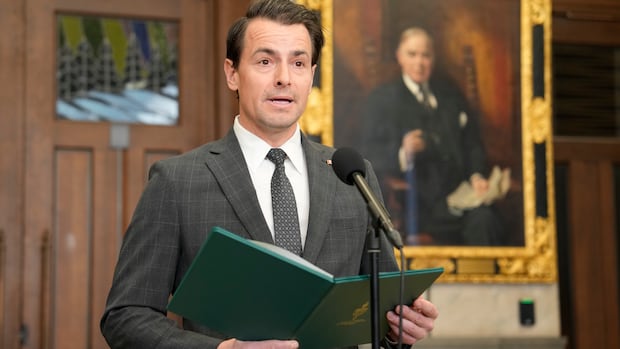
For years, the cry from Canadian sport was, “if only we had the resources,” federal Secretary of State for Sport Adam van Koeverden said in his opening remarks. “Now, we do.”
A mixture of NSO executives, private-sector leaders, athletes, philanthropists and more convened with van Koeverden to discuss how best to use the government’s nine-year, $2.5 billion investment into sport, which includes $1.5 billion toward infrastructure announced in last week’s budget, and how to modernize the sports system as a whole.

CBC Sports’ Donnovan Bennett sat down with Canada’s secretary of sport, Adam van Koeverden, among others, to discuss Canada’s current sporting system, and how it can be rebuilt.
It wasn’t a day full of news or groundbreaking announcements. Panel discussions were useful to some, less so to others. A workshop with 100-plus people can only be so valuable.
“I don’t know if I really recorded any direct quotes, but it was like a lot of different ideas were coming together. Just making those connections and thinking of things differently,” said 14-time Paralympic biathlon and Nordic medallist Mark Arendz.
There was, however, a sense of cautious optimism. Reason to believe things are on the track to change for a system that has been underfunded and broken. Collaboration. The sprouts of some ideas — born partially in boardrooms and partially from coffee breaks at a government in the heart of downtown in the country’s capital by the Rideau Canal.
Those relationships are what Hockey Canada CEO Katherine Henderson intends to build on after the summit ends.
“I think there’s some goodwill and almost permission for us to start to really sit down and take a look at the business of sport, the things that we run together more collaboratively and more strategically and I think the minister [van Koeverden] is setting an expectation that we will do that. It’s not a nice-to-do, it’s a must-do,” Henderson said.
A New Game Plan Series
Indeed, what comes next won’t be formally decided in two days in Ottawa. It is, however, that first step — a networking event that strives to move toward a solution at Eliud Kipchoge-level pace. Quickly, but in a well-thought-out manner.
A member of the board of directors at Surf Canada arrives in part to thank the government for the $335,000 in additional funding his organization received (boosting its annual total to $435,000) and in part to pick the brains of other sports bodies on how best to increase participation in his sport.
Arendz, also the chair of the athlete committee of the International Biathlon Union, crosses paths with Benoit Girardin, a UOttawa professor with interest in his sport. They’re arranged to chat further later.

Liberal MP Adam van Koeverden announced on Thursday the federal government is investing an additional $60 million to ‘deliver more sport programming’ and build Canada strong ‘from playground to podium.’
Miranda Ayim, the basketball player who was inducted into the Canadian Sports Hall of Fame just last week, sat in on sessions and had visions of new funding keeping Canada’s top women at home.
“This is the day of dreaming and reaching for the sky. I would love to see a domestic women’s league here in Canada,” Ayim said.
To begin Day 1, Chief Wilton Littlechild — also inducted to the Sports Hall — gave the opening speech, pleading with the group to take a “worm’s-eye view” in order to build out a 10-year plan.
He was followed by van Koeverden, whose message was to talk about everything — that nothing is impossible in this “new era” of Canadian sport.
Van Koeverden was next joined on stage for a panel including businessman Bruce Croxon, longtime tennis executive Stacey Allaster and Olympic track champion Bruny Surin.
Croxon, a former panellist on Dragon’s Den, urged the crowd to make decisions that feel uncomfortable and to celebrate success to levels that may even feel unCanadian.
“F–k man, we’re unbelievable,” he said, drawing the biggest crowd reaction of the morning.
Ayim agreed with the notion.
“I think there’s beauty in [humility] and I think that’s why Canada’s beloved internationally. But there is a time and a place to pat yourself on the back or pat each other on the back,” she said.
Allaster referenced Billie Jean King’s vision and execution for the WTA. Surin spoke on leadership.

CBC Sports reporter Karissa Donkin has been travelling near and far to help determine ‘A New Game Plan’ for Canada’s sports system.
Then, the doors closed to media. After one more panel focusing on investment, the group split into separate rooms for breakout sessions on the same topic, then back to two more panels and a workshop to chat about transformation.
Tuesday, alignment will be a theme — but it’s already beginning to take shape, according to Henderson.
“All of us that were sitting around the table, one of the things that we realized is we live in this really complicated system of federations that when Hockey Canada or Volleyball Canada or Soccer Canada, when we make one move it actually affects a whole bunch of different organizations,” Henderson.
One day, we could look back at these two days in Ottawa and say they mattered greatly. That they truly did set the path toward a new era in Canadian sport. That change began here.
“Staying the same is not going to help us. We need to be making changes. Sometimes that’s a small change, sometimes it’s big, and sometimes it’s going to be both. I think we’re in a moment where we can do both, and that’s really exciting,” Arendz said.
For today? It was just that uncertain first step of the marathon. Forty-two kilometres to go.
Leave a Reply