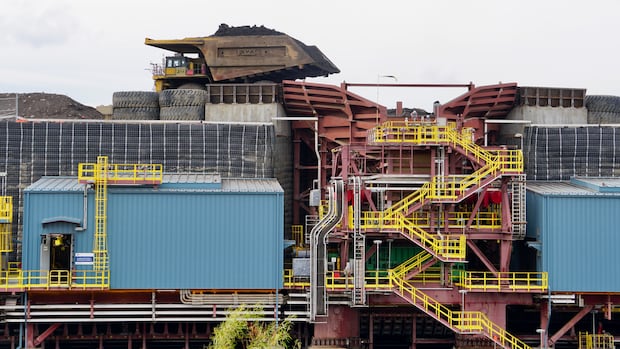
The Alberta government is preparing to unveil new subsidies later this month for oil companies to ramp up production in order to help fill the province’s proposed Pacific Link pipeline to the West Coast.
The incentives would come as the largest oil producers are posting billions of dollars in profits in their latest financial results and the industry as a whole is experiencing one of its most lucrative years over the last decade.
Suncor Energy, Cenovus Energy, Canadian Natural Resources and Imperial Oil posted combined profits of more than $12.5 billion in recent quarterly earnings reports. The Canadian oil and gas industry is forecast to post revenues of more than $200 billion in 2026, according to Studio Energy, after oil prices climbed above $100 US per barrel several times this year amid the U.S.-Iran war.
That’s why some industry experts question why new subsidies are needed.
“What kind of incentives does the oil and gas sector really need?” said Janet Annesley, a former executive with Husky Energy and Shell Canada, on CBC Radio’s Alberta at Noon.
“They’ve got money, they’re buying back shares, they’re flowing lots of dividends to shareholders. So what really more do we Albertans have to do to get them to make investments here and have more projects?”
Premier Danielle Smith, Annesley said, will have to “prosecute the case with Albertans about why we should be giving more incentives to oil companies.”
Oil production is already at record levels, but with several new and expanded pipeline projects in development, there is uncertainty whether the industry will pump out enough crude to justify beginning construction on the Pacific Link — for which Smith wants construction to begin in fall 2027.
The province is seeking to create an “alternative enhanced royalty structure,” according to Smith, to incentivize companies to commit to growing oil production.
“We hope that once that is on the table and they know all of the factors that would go into it, I suspect that you’re going to see a lot of interest in being able to fill that pipeline,” Smith told journalists in Fort McMurray, Alta., in September.
More oil wanted
The new subsidy is expected to be aimed at the oilsands sector, since that is the source of most oil production in the province and new projects are often large enough to noticeably increase overall production levels.
The Alberta government already provides a financial incentive to oilsands companies to build new projects, since they pay much lower levels of royalties to the government during the first few years of operation.

A view of Suncor’s Base Plant oilsands mine. Suncor is one of the companies considering whether to proceed with expanding production in the oilsands. (Kyle Bakx/CBC)
Already, some companies are hinting at potentially moving quicker to build new projects.
Imperial Oil was considering a decision to proceed with its Aspen oilsands project by the end of the decade, but chief executive John Whelan said that could occur sooner.
“We are looking at do we want to bring it forward,” he said, during a conference call with analysts on Oct. 30, while acknowledging the company is encouraged by steps taken by the provincial and federal governments to support the sector.
Suncor executives are looking at their growth plans over the next several years and contemplating how they could potentially move faster, if they decide to, said chief executive Rich Kruger.
“We’re asking ourselves and doing some preliminary work,” he said, during a conference call with analysts on Nov. 4.
“We’re all anxiously waiting to hear more from the province on royalties and incentives there. The parties are all sleeves rolled up, meeting endlessly, working hard together.”
The Oil Sands Alliance would not comment on the proposed Alberta incentives until an actual announcement is made.
Introducing a deadline
Some oil companies could be hinting at possible growth plans as a way to alert investors and gauge their interest. Despite lucrative oil prices, many investors would rather oil companies continue to produce hefty profits for shareholders, as opposed to spending billions of dollars to invest in new projects.
Many investors are enjoying the robust profits and are reluctant to give up the cash they collect, says Mark Little, the former chief executive of Suncor.
The company leaders are “testing investors’ appetite for expansion,” said Little, to hear if they will support growth plans or if they warn not to do it.
“To me, the biggest uncertainty on growth isn’t the [federal government], it’s not the province, it’s not money,” said Little, “It’s whether the investor will support it.”

Former Suncor executive Mark Little, pictured in 2022, says the current Alberta royalty system works well. (Kyle Bakx/CBC)
The last large oilsands project to be constructed was nearly a decade ago, which is why Little says it’s important for the industry to make investments to ensure the sector’s long-term future.
“I almost call it the ‘liquidation phase’ because all we’ve been doing is basically producing, spending as little as possible, and handing the cash back to the shareholders,” he said.

An aerial view of an oilsands mine north of Fort McMurray, Alta. Oil production continues to increase as companies expand and improve existing facilities. (Bob Grieve/CBC)
The Alberta government’s move to introduce a new incentive is “mystifying,” said Little, since the current royalty system is already sophisticated, flexible and works well. However, he could see merit in the provincial government introducing a deadline for companies to develop the properties they own.
Production from the oilsands continues to increase as companies invest in expansion projects and find ways to improve existing operations.
Lennie Kaplan, who previously served as a senior manager with the Treasury Board, estimates that some level of incentives are necessary for companies to spend billions of dollars to build new large-scale oilsands projects.
“These projects are very capital intensive,” he said, about the level of investment required.
For the Alberta government to reach its goal of doubling oil production, Kaplan’s calculations estimate the government would need to provide $115 billion of incentives between 2027 and 2050, which includes $95 billion of royalty relief and $18 billion of additional construction subsidies. Under that scenario of normal oil prices, as forecast by Alberta Energy, the government would collect an additional $250 billion in royalties.
However, in a scenario with low oil prices, the government would need to provide $240 billion of incentives and yet experience a net fiscal loss of $80 billion.
Kaplan’s modelling does account for other considerations, including a rising industrial carbon tax, which he said is important considering the Alberta government still pledges to be net-zero by 2050.
Leave a Reply